
The Wastewater Pretreatment Gap: How America’s Wastewater Systems Became Conduits for “Forever Chemicals”
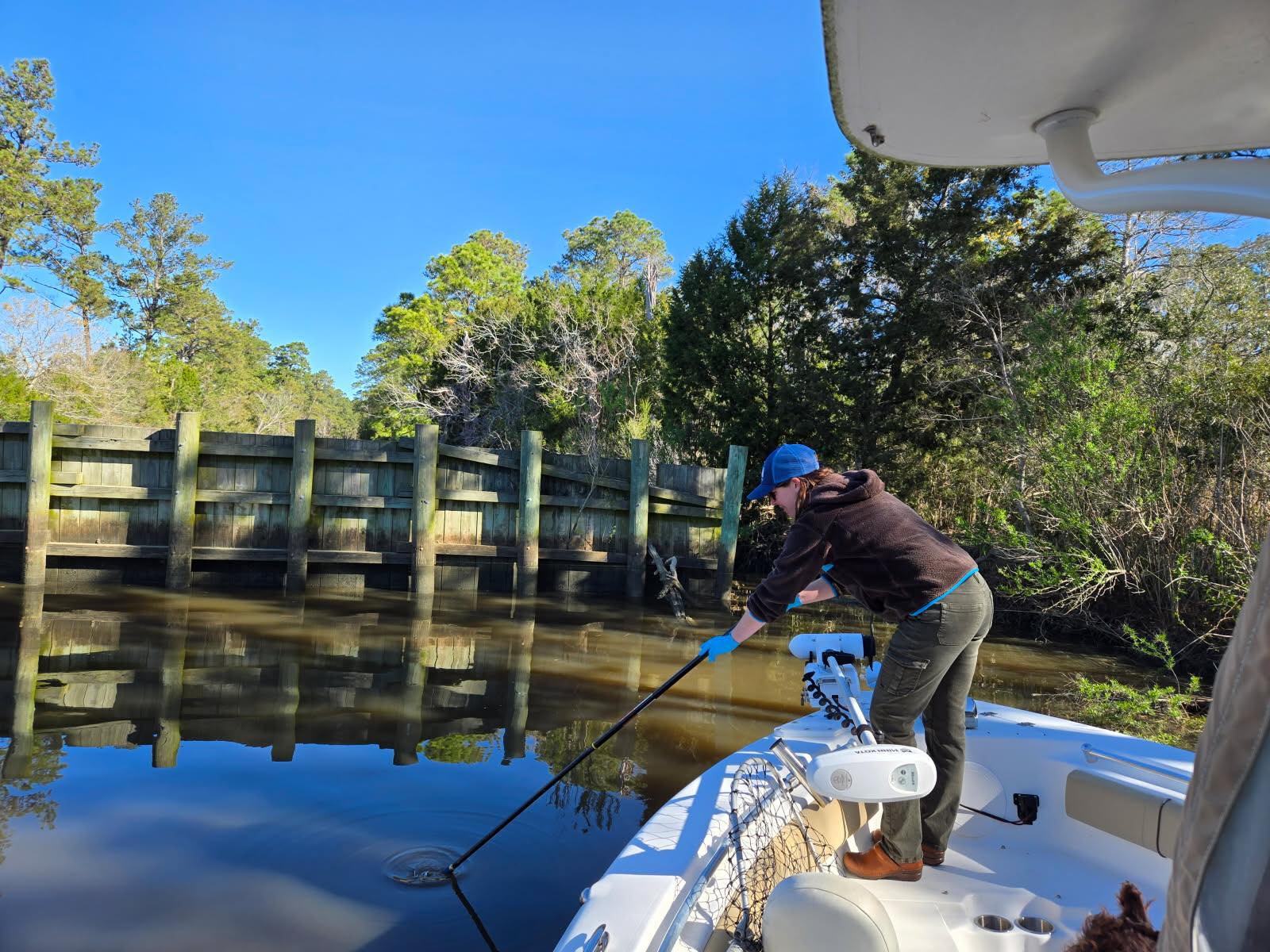
On a hot, sunny day in August of 2024, Erin Donmoyer waded into the east branch of South Carolina’s Pocotaligo River and removed a “PFASsive passive sampling device” from its protective case. The gadgets are designed to measure PFAS concentrations in waterways. PFAS—short for per- and polyfluoroalkyl substances—are a class of more than 15,000 man made chemicals used in everything from cookware to microchip manufacturing. Some of these “forever chemicals” are known to cause cancer in humans. Donmoyer secured the sampling device to a stake in the riverbed and marked its GPS coordinates. She installed two of these devices in the Pocotaligo that day, placing one upstream of Sumter, South Carolina’s wastewater treatment plant, and another downstream of it. There the devices remained for 33 days, quietly accumulating whatever PFAS flowed past.
When she analyzed the results, Donmoyer was surprised. As a riverkeeper at Winyah Rivers Alliance—a Conway, South Carolina-based nonprofit and A2 member working to protect, preserve, and revitalize the Winyah Bay watershed of the Carolinas—Donmoyer stewards two of the region’s major river systems: the Black River and the Sampit River. (The Pocotaligo is a major tributary of the Black River). Of these two river systems, Donmoyer expected the Sampit, lined with paper mills and chemical plants, to be the one with elevated PFAS levels “But it really wasn’t,” Donmoyer says. “In terms of PFAS, the Black River is the major problem child out of my two.”
The Black River system is among the most PFAS-polluted waterways in the entire country, Donmoyer discovered. PFAS levels are particularly pronounced in the Pocotaligo, and much of this pollution seems to be coming from Sumter’s wastewater treatment plant. Upstream of the plant, Donmoyer’s sampling device logged PFAS concentrations of 118 parts per trillion. Downstream, levels spiked to 228 parts per trillion—a 107 percent increase. It was the highest contamination found at any of the 22 wastewater treatment plants tested in a nationwide study directed by the Waterkeeper Alliance in 2024, in which Donmoyer’s findings were published.
The Sumter plant serves roughly 51,000 people and receives wastewater from about two dozen industrial users, including metal coating facilities, plastics and tire manufacturers, textile operations, and chemical plants. All of these industries use PFAS in their manufacturing processes, and all of them generate large volumes of PFAS-contaminated water. The Sumter plant has no PFAS removal technology. It has no limits on how much PFAS it can discharge into the Pocotaligo River, which flows into the Black River, which flows into the Great Pee Dee River, which flows into Winyah Bay and, ultimately, the Atlantic Ocean. From the wastewater it treats, the Sumter plant also produces over 1,000 tons of PFAS-laden sewage sludge each year. Much of this sludge is shipped to Florida, where it is spread and sprayed on farmland as fertilizer.
“This facility, which has the highest levels of PFAS pollution out of all the sites studied in the nation, is now sending their pollution to Florida as well,” Donmoyer says. “It ends up in livestock and crops—everything, forever.”
She’s not exaggerating. Thanks to their remarkably sturdy carbon-fluorine bonds, PFAS don’t break down or biodegrade—not on any human timescale, at least. Once released into the environment, they persist for incredibly long spans of time, contaminating air, water, and soil and bioaccumulating in the tissues of plants, animals, and people. Some of these chemicals, such as perfluorooctanoic acid (PFOA), are classified as carcinogens by the International Agency for Research on Cancer. Others, such as perfluorooctane sulfonic acid (PFOS), are classified as “possible carcinogens.”
PFAS are, in short, just about the last thing you want in your food or water, and Sumter’s wastewater treatment plant is dumping untold numbers of them into the Pocotaligo River—and shipping truckloads of them to farms in Florida.
This isn’t just a Sumter, South Carolina, problem. Across the country, industries discharge PFAS-contaminated water into municipal wastewater systems that weren’t designed to remove them. Wastewater treatment plants, funded by taxpayers, inherit pollution they didn’t create and cannot eliminate, then pass it on to ecosystems and communities downstream—and to farmlands across the nation. Of the 22 wastewater treatment facilities examined in the Waterkeeper Alliance’s 2024 study, only one had any PFAS limits in its discharge permit. None had PFAS removal technology. These facilities collectively serve tens of millions of Americans. All of this is perfectly legal under current federal regulations.
While the EPA has set drinking water limits for some PFAS—including PFOA and PFOS—there are no federal regulations on how much of these forever chemicals industries can discharge into public wastewater systems, or how much of these forever chemicals public wastewater systems can discharge into rivers and streams. Let’s call it the “wastewater pretreatment gap”: companies profit from using PFAS in their industrial processes, send their PFAS-polluted water to public wastewater treatment plants unequipped to filter PFAS, and leave downstream communities to deal with the health consequences and cleanup costs.
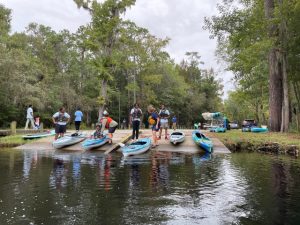
Kayakers on the Black River. Photo: courtesy of Winyah Rivers Alliance.
This regulatory gap has predictable consequences: low-income communities and communities of color are bearing the brunt of this pollution.
In South Carolina, downstream from Sumter’s wastewater treatment plant, locals fish from the Black River and its tributaries for subsistence. “There are a lot of predominantly African American communities that go to the river to fish for their families, for food,” Donmoyer says.
At Brewington Lake, where the Pocotaligo flows into the Black River, state testing has revealed PFAS concentrations as high as 7,600 parts per trillion. Adverse health effects stemming from PFAS exposure can occur at doses as low as two parts per trillion.
“We also have fish tissue data that the state collected from that same location,” Donmoyer says, “and they were like, I mean, astronomically high. One species was four times higher, and one species was nine times higher than what North Carolina says is safe to eat in fish.” Donmoyer herself has autoimmune issues from high mercury levels as a child—the result of eating locally caught fish. Now she’s watching a new generation eat PFAS-contaminated fish.
This pattern of PFAS pollution disproportionately affecting vulnerable communities repeats across the country. The Vermont PFAS/Military Poisons Coalition—a Burlington-based A2 member fighting to keep Vermonters safe from forever chemicals—has documented similar problems in the Winooski River. Testing conducted by the group has revealed “huge amounts of PFAS” in the Winooski, downstream of a Vermont Air National Guard Base that utilizes PFAS-containing firefighting foams.
“My community was a refugee resettlement community, so it was the most diverse community in the state of Vermont,” says Marguerite Adelman, who co-founded the organization in 2019. “Many resettled refugees fish in the Winooski River, downstream from fire training sites where they use these firefighting foams.” These communities, having fled hardships elsewhere, now face PFAS exposure in what they hoped would be a safe haven.
Move Past Plastic—another A2 member based in Carlisle, Pennsylvania—has discovered much the same thing in the state’s Conodoguinet Creek watershed. In collaboration with scientists from the American Geophysical Union’s Thriving Earth Exchange, the organization mapped PFAS pollution in the watershed in 2023. The mapping project identified PFAS hotspots clustered around several legacy landfills, industrial sites, military bases, and wastewater treatment plants. State testing in public supply wells near one of the area’s old textile manufacturing sites has logged PFAS concentrations as high as 8,500 parts per trillion.
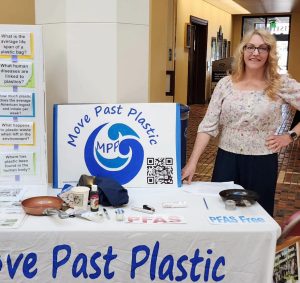
Tamela Trussell tabling for Move Past Plastic Photo: Move Past Plastic.
There are a million wells in Pennsylvania that people rely on for drinking water, says Tamela Trussell, who founded Move Past Plastic in 2021. “These wells aren’t regulated. The water isn’t regulated. They don’t have mandatory testing for any chemical.”
All three of these groups—Winyah Rivers Alliance in South Carolina, the Vermont PFAS/Military Poisons Coalition, and Move Past Plastic in Pennsylvania—have independently discovered PFAS pollution in their own backyards. All three groups are working to educate the public about the dangers of PFAS pollution. All three groups are pushing for better PFAS regulations at both the state and federal levels. And all three groups agree on where to start: closing the wastewater pretreatment gap.
“If facilities absolutely have to use PFAS, then the impetus needs to be on them to remove it before it’s put in a public entity that’s funded by tax dollars,” Donmoyer says.
Trussell echoes this sentiment: “I think the step we need to take, in addition to regulating maximum contaminant levels in drinking water, is to regulate the discharge.”
Wastewater pretreatment requirements—requiring industries to remove PFAS from water before discharging it into public wastewater systems—would fundamentally shift the economic equation. Instead of externalizing the costs of PFAS use onto the public, companies that profit from these chemicals would bear the expense of managing them safely. “If you identify the problem, then you can put it back on the factories and say, ‘No, we don’t want that. We’re not going to accept this pollutant and make it a ratepayer issue,” Donmoyer says.
Pretreatment requirements would fix that sewage sludge issue, too. If the water that wastewater treatment plants receive doesn’t contain PFAS, neither will the biosolids these plants produce. “That’s another priority area,” Adelman says. “We want to get PFAS-containing biosolids and sludge banned from being spread on farmers’ fields.”

Marguerite Adelman and members of Vermont PFAS/Military Poisons Coalition at Advocacy Day in Montpelier. Photo: Vermont PFAS/Military Poisons Coalition.
We have the technology to pull this off. Reverse osmosis and other advanced filtration systems have been shown to reduce PFAS levels in water by more than 99 percent. Some wastewater treatment facilities have already installed such systems. The question is who pays for them—and when the filtration happens.
“Many of our state agencies and the EPA already have grounds to take action on these polluters,” Donmoyer says. “We have the Clean Water Act, which says that you cannot just dump any sort of pollutant into the waters of the U.S. without a permit saying you can do that, and most of these companies don’t have PFAS listed on their permits.
“There’s an existing legal avenue to stop PFAS pollution, but many places, including South Carolina agencies, are not utilizing the authority they have to stop it.”
The wastewater pretreatment gap isn’t the only problem with PFAS regulation in the United States, but it may be the most glaring: industries discharge unlimited amounts of forever chemicals into public systems that can’t filter them, leaving every community downstream—and every farm receiving biosolids—at risk. The technology to prevent this exists. The legal authority to prevent this exists. What’s missing is the political will to make polluters, rather than the public, pay the price for poisoning our water.
Newsletter Sign Up
Don’t miss any of our newsletters!

