
Something in the Air: How a Louisiana environmental group mapped air pollution in “Cancer Alley”—just as federal support for environmental justice collapsed
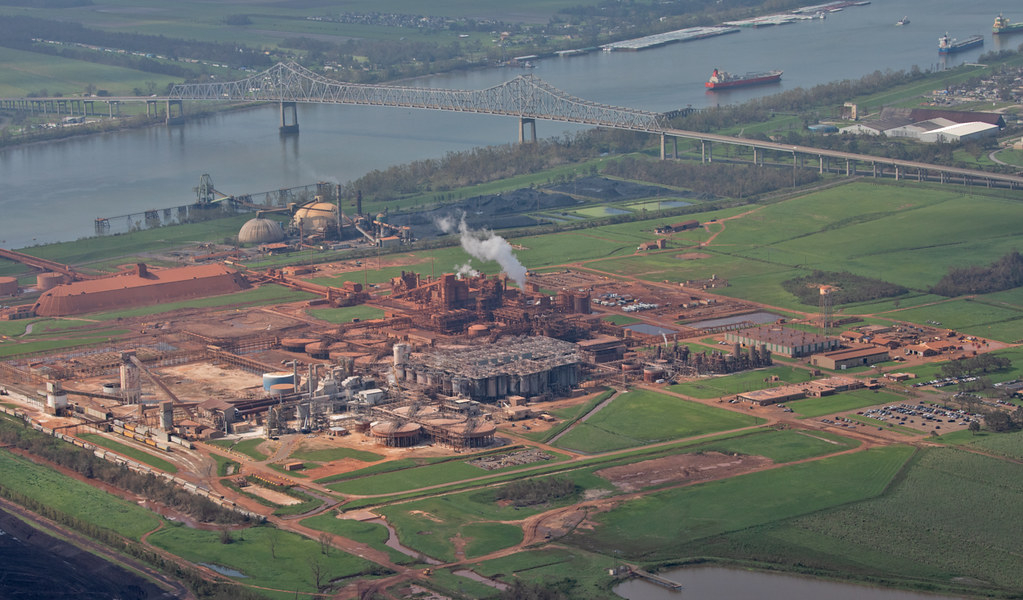
For three months at the beginning of 2024, a fleet of vehicles equipped with air-sampling sensors drove the length of Louisiana’s “Cancer Alley.” The route ran 300 miles along both sides of the Mississippi River, through the industrial corridor between New Orleans and Baton Rouge, where hundreds of petrochemical plants, refineries, and other industrial facilities operate. The cars ran around the clock—twenty-four hours a day, seven days a week, sampling air every second—measuring ozone, black carbon, fine particulate matter, nitrogen dioxide, carbon dioxide, and carbon monoxide, among other pollutants.
The project was funded by a $500,000 grant from the Environmental Protection Agency, awarded to the Louisiana Environmental Action Network in 2023 as part of the Biden administration’s Inflation Reduction Act. The Louisiana Environmental Action Network (LEAN), a grassroots group based in Baton Rouge, hired an air pollution mapping company called Aclima to conduct the monitoring. By mid-March of 2024, when the cars completed their run, they had generated 50 million data points. Analyses identified 27 areas of elevated pollution—hotspots that communities in Cancer Alley had long suspected but had never been able to document with this level of precision.
The timing, as it turned out, was significant. The mobile monitoring project concluded, and was moving into its second phase, just as the federal commitment to environmental justice—federal efforts to address pollution in communities of color and low-income areas—began to unravel.
On January 20, 2025, hours after taking office for his second term, President Trump signed an executive order revoking two of President Biden’s directives on environmental justice and climate policy. The following day, he signed another order revoking Executive Order 12898, issued by President Clinton in 1994, which had directed federal agencies to address disproportionate environmental burdens in low-income communities and communities of color. That order had been the cornerstone of federal environmental justice policy for more than three decades.
Within weeks, the EPA closed its Office of Environmental Justice and placed roughly 170 staff members on administrative leave. The agency removed EJScreen—an online mapping tool that had allowed communities, regulators, and researchers to identify areas facing disproportionate pollution—from its website. The Department of Justice rescinded its environmental justice enforcement strategy. Across the country, approximately $29 billion in environmental justice and renewable energy grants were canceled or frozen.
For Marylee Orr, LEAN’s executive director, the shift in atmosphere was unmistakable. “I’ve never been through anything like this,” she says, “and I’ve been doing this a long time.”
Orr has been doing this work for nearly forty years. She founded LEAN in 1986, though the organization’s origin story begins earlier, when her son was born with a lung disease that made it hard for him to breathe. “They told me he could be blind, deaf, brain-damaged, have cerebral palsy, or be susceptible to respiratory problems,” Orr says. That year, Baton Rouge’s air quality exceeded healthy levels on seventeen separate occasions. “And so I became an empowered mother.”
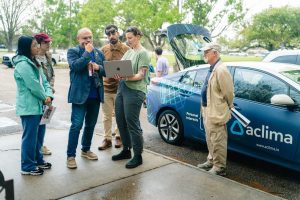
LEAN members, community leaders, and Aclima scientists pray at Mount Triumph Baptist Church in St. James Parish, LA, on March 16, 2024. Photo: Zachary Kanzler/LEAN
Not long after her son was born, when the city announced plans to incinerate PCBs—a group of highly toxic industrial chemicals linked to cancer and other serious health harms—in North Baton Rouge, a community that was 98 percent Black, Orr founded “Mothers Against Air Pollution.” She went door to door collecting signatures, building community resistance and rallying support.
LEAN was founded in Orr’s living room shortly thereafter by a coalition of civil rights activists, labor organizers, environmentalists, doctors, and empowered mothers. It took the group a year and a half to agree on a name. They wanted each word to mean something: Louisiana (homegrown), Environmental (a deliberate choice over “conservation,” which at the time was associated with hunters and anglers who largely resisted environmental advocacy), Action (not merely discussion), Network (strength through community).
The organization operates with what Orr calls a “bottom-up” structure. “We’re not your savior,” she tells communities where LEAN works. “This is where youlive. We can offer you this tool, but if you don’t want it, we’re guests.” With a staff of fewer than ten, the organization relies on partnerships, volunteers, and contracted expertise. Over four decades, the organization has supported grassroots campaigns that shut down the Marine Shale Processors hazardous waste facility in Amelia in the early 1990s, pioneered cooperation between environmental groups and labor unions during the BASF lockout of the 1980s, and secured reforms to Louisiana’s water permitting practices after Hurricanes Katrina and Rita. The group responded to those disasters as well—along with the BP oil spill—coordinating immediate emergency relief and advocating for habitat restoration in the aftermath.
The air monitoring project represented a culmination of sorts. LEAN spent roughly half of its EPA grant money to hire Aclima, whose mobile units Orr refers to as “Harry Potter Cars” for their seemingly magical ability to make invisible pollution visible. The vehicles ran continuously from December 2023 through mid-March 2024, covering a route that passed through more than 20 communities along the Mississippi, most of them majority Black and low-income. The Harry Potter Cars sampled air every second, logging the data in real time. They measured not only conventional pollutants like carbon dioxide and particulate matter, but also toxic compounds like benzene, toluene, ethylbenzene, and xylene. “We got 50 million data points, which is really 50 million pollution points, right?” Orr says. “And we identified 27 areas of great concern.”
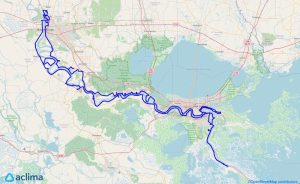
A map of the route followed by Aclima’s “Harry Potter Cars.” Photo: LEAN
“And then this is where the new administration came in, and things kind of fell apart,” she continues. “They froze money and all that kind of stuff. But we’re following up with stationary monitors in places where we were seeing issues.” Some of them, at least. Before their funding was frozen, LEAN had planned on installing stationary air quality sensors in all 27 communities flagged by the mobile monitoring project. By the time Trump took office for his second term, however, the organization had only managed to install four such sensors, placing them in Alsen, Geismar, St. James, and Donaldsonville. The sensors, which went live in September 2024, have been publishing data to LEAN’s website every 15 minutes ever since, measuring carbon dioxide, carbon monoxide, sulfur dioxide, nitrogen dioxide, hydrogen sulfide, ozone, fine particulate matter, and an array of volatile organic compounds. They also track wind speed and direction—information that helps determine pollution sources.
These data points have already yielded insights. Slawomir Lomnicki, a professor of environmental science at Louisiana State University who advises LEAN, reported spikes in volatile organic compounds in Geismar late last year. “When we look at the correlation between atmospherical conditions and these pollutants,” Lomnicki told the local press, “in many cases, you can see a very clear correlation with the direction from where the plume is coming.” Unsurprisingly, many of these pollution plumes seem to be coming from nearby petrochemical plants and other industrial facilities, the data show.
Louisiana ranks third nationally among states and territories for toxic emissions per square mile, according to the EPA’s Toxic Release Inventory. In 2024, the latest year for which data is available, 395 facilities in the state emitted more than 127 million pounds of pollution, as compared to 404,000 pounds in New Hampshire. For communities in Cancer Alley, the health effects have long been evident—elevated rates of respiratory illness, cancer, and other maladies—but quantifying exposure has been difficult. LEAN’s monitoring project was designed to bridge that gap.
Yet even as the project was getting underway, it faced resistance. In May 2024, the Louisiana Legislature passed what it called the “Community Air Monitoring Reliability Act.” The law established equipment standards for community air monitoring and prohibits data collected by systems that don’t meet those standards from being used in enforcement actions, regulatory proceedings, or lawsuits under the federal Clean Air Act. The standards are expensive. State-approved regulatory monitors can cost upward of $500,000. LEAN’s stationary sensors cost a fraction of that amount. They were calibrated against state equipment and found to meet EPA thresholds for data comparability, but they don’t qualify as “regulatory grade” under Louisiana’s new law.
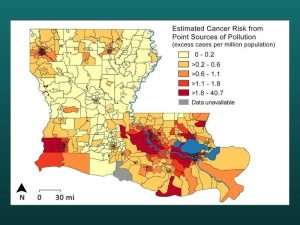
Cancer risk from point sources of pollution in Louisiana, as reported in the EPA’s National Air Toxics Assessment. The Mississippi River is shown in blue. Image: EPA
The practical effect is that LEAN can collect data, publish it, and share it with communities, but cannot use it to compel polluters to comply with environmental laws. “They’re saying they are not taking away air monitoring,” Orr told the press at the time, “but it seems like they want to take the teeth out of it. They’re taking away the thing that seems to scare the people who are behind this bill, and that’s people having the right to know what they’re being exposed to.”
In May of last year, six environmental groups filed a federal lawsuit challenging the law as unconstitutional. LEAN isn’t among the plaintiffs, but the organization’s work illustrates what the lawsuit describes as the law’s impact: community-collected data, no matter how accurate, is rendered legally inadmissible.
Louisiana isn’t alone in muzzling community air monitoring projects. Kentuckyenacted a similar law in 2024, and comparable legislation has been proposed in West Virginia and Ohio.
For organizations like LEAN, the challenges are compounding. Beyond these regulatory obstacles, there is, of course, the matter of funding. “It’s a very difficult time for nonprofits,” Orr says. “Really, really difficult.” The federal grants that once supported projects like LEAN’s air monitoring network have largely disappeared. Fundraising has become increasingly difficult. Even the language has become fraught. LEAN is, by definition, an environmental justice organization—it always has been—but in the current climate, using those words can be costly. “We have to be really careful,” Orr says, “because they can do things if you’re using ‘environmental justice’ in your language.”
And yet the work continues. The group’s stationary monitors remain operational, uploading data every 15 minutes. LEAN meets regularly with community members to discuss findings and facilitates conversations between residents and nearby companies about voluntary emissions reductions. In an unusual development, International-Matex Tank Terminals, a bulk liquid storage facility in St. Rose, recently approached LEAN to partner on air quality monitoring. Such facilities can emit volatile organic compounds, polycyclic aromatic hydrocarbons, and other hazardous air pollutants during storage and transfer operations. The company has installed four sensors around its facility and is publishing its data directly to LEAN’s website—a model Orr hopes other companies might follow.

Marylee Orr (center) poses with LEAN members at their 2024 Summer Educators Workshop. Photo: LEAN
Meanwhile, the air monitoring dashboard—publicly accessible on LEAN’s website—is providing communities in Cancer Alley with something they have never had before: real-time, hyperlocal data about the air they breathe. Whether that information will translate into regulatory action or legal accountability remains uncertain. What is clear is that the pollution is visible now, documented in ways it has never been before.
Forty years into this work, Orr maintains a certain steadiness. The funding may evaporate. The regulatory framework may collapse. The terminology may shift. But the pollution persists, and so do the communities living with it. LEAN, Orr says, isn’t going anywhere.
“I’ve never been through anything like this,” Orr says again of the last year, two months, two weeks, and five days. Then, after a pause: “But we’re still here.”
Newsletter Sign Up
Don’t miss any of our newsletters!

