
How Memphians are holding xAI accountable

“A sacrifice zone.” That’s how KeShaun Pearson describes the way Elon Musk’s xAI has treated the historically Black neighborhood of Boxtown, Southwest Memphis, next to which it rapidly set up the world’s largest supercomputer in the summer of 2024.
Named Colossus, the sprawling data center went live within record time—just 122 days. To power it, 35 methane turbines were driven in without environmental permits. Residents learned from the news that the AI data center, which requires vast amounts of energy, was opening in their area.
“People had a really visceral reaction,” says Pearson, executive director of Memphis Campaign Against Pollution (MCAP), an A2 member. “They felt deeply disrespected. This continues to be the story of southwest Memphis, where corporations [choose] somewhere where there is a high concentration of Black folks who are also low income, though they own their property. We aren’t being included in decisions about our everyday life, about the air we’re going to breathe.
“That’s why we use the term sacrifice zone: you could only operate in this way if you don’t believe these folks’ lives matter as much as the next person.”
Air pollution
Boxtown’s air has long been marred by heavy industry, including a steel mill, an oil refinery, and a gas-fired power plant. Local residents are four times more likely to get cancer than the average American, while Memphis is one of America’s “asthma capitals.”
According to research commissioned by TIME, peak nitrogen dioxide concentration levels jumped by 79% compared with pre-xAI levels in the areas immediately surrounding the facility, and by 9% in Boxtown. “There’s sort of a bitter taste to the air,” says Pearson, adding that a sulfuric smell hangs in the atmosphere.
xAI supported the massive energy needs of Colossus 1 – one of its three facilities in the region – using methane turbines, leaning on a loophole that said permits were not necessary for the generators provided they’re not in the same location for more than 364 days. In 2025, satellite thermal imaging captured by the Southern Environmental Law Center showed that 33 turbines, which emit smog-forming nitrogen oxides, the carcinogen formaldehyde, and fine particulate matter, were active at once. Fine particulate matter significantly raises the risk of serious health conditions, including asthma, heart attacks, respiratory disease, and strokes.
MCAP co-led the fight to push xAI’s unpermitted turbines out of Memphis. That effort bore fruit in January, when the Environmental Protection Agency (EPA) ruled that the company’s generators required air permits, even if they are used on a temporary basis. Pearson yelled out in excitement upon hearing the news: “Having the EPA support our stance is major. Had they not ruled in our favor, we’d know we were still fighting for the right thing – but it definitely feels great. It was almost like a weight was lifted.”
The EPA’s ruling – coming at a time when the Trump administration has gutted climate and environmental protections – felt like a real win. xAI had received permits for 15 turbines in July 2025, which required it to fit turbines with Selective Catalytic Reduction systems to reduce pollutants. At the last count, Pearson says, Colossus 1 still had 13 turbines active. With air pollution in neighborhoods like Boxtown already dangerously high, these turbines just “don’t need to be there,” he stresses.
The company’s data center expansion has also continued at a breakneck speed. xAI launched Colossus 2 (named MACROHARD) in mid-January at a Whitehaven site on Tennessee’s periphery, powered by dozens of turbines just over the Mississippi border in Southaven. Musk’s announcement that the second site was live came just after the EPA ruled that permits were required for generators. A third xAI data center, also in Southaven and dubbed MACROHARDRR, is under construction.
Even though these turbines are just over the border, the proximity to South Memphis means these facilities are “still affecting our entire region,” Pearson says, as well as people in Southaven. Thermal images captured by Floodlight, nearly two weeks after the EPA’s ruling, showed more than a dozen unpermitted turbines burning gas at xAI’s facility in Southaven, and hundreds of residents turned out to urge regulators to reject xAI’s application for 41 new turbines in February.
xAI did not respond to a request for comment.
Pearson believes xAI chose to cross the border with Colossus 2 due to “a belief that Mississippi isn’t organized and can be exploited.” But activists across the region are mounting a fightback, working hand in hand: in Mississippi and Arkansas, A2’s state organizing committees are bridging together organizations to hold Big Tech accountable, while such alliances are also beginning to take shape in Missouri, Oklahoma, Louisiana, and Arizona with the support of A2 community organizers.
Energy
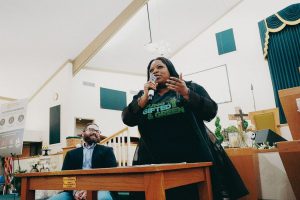
Young, Gifted & Green CEO LaTricea D. Adams speaks during a town hall regarding xAI and its impact on the city on 12 April 2025, at Mount Pisgah Baptist Church in South Memphis. Photo: courtesy of Young Gifted & Green.
xAI has now built two substations, which would allow it to draw up to 300 megawatts (MW) from the Memphis grid for Colossus 1. Memphis largely relies on fossil fuels to generate electricity, with the Tennessee Valley Authority (TVA) recently greenlit to build six new methane-gas turbines.
Campaigners say 300MW is enough to power 200,000 homes, and some Memphians have questions about whether data centers drawing on the grid could raise their energy bills or even contribute to outages.
LaTricea Adams, the president of Young, Gifted and Green, an A2 member that worked alongside MCAP to hold xAI accountable, says in some postcodes, outages have become a regular issue over the last decade. The grid needs more investment for maintenance, she says, and “in combination with climate change, the issue has become even more pronounced.”
Historically Black neighborhoods in South Memphis are particularly vulnerable to outages during bad weather, as their power lines are above ground. While Adams adds that there is no evidence that xAI is contributing to outages at this stage, residents remain uneasy.
Residents are also concerned that data centers, which require vast amounts of power, could cause local utility bills to rise at a time when bills have already skyrocketed. The fear is that data centers could not only raise demand but also necessitate energy infrastructure upgrades, with ratepayers absorbing the costs.
Young, Gifted and Green wants xAI to use renewables to power its facilities, rather than draw on a grid that relies heavily on fossil fuels for electricity generation. Adams says xAI should focus on how it can make its data centers use “as much solar as possible to divest from using fossil fuel-generated power.” It is also calling for the development of community solar.
Given their enormous energy burden, can data centers ever really be green? Adams refers to Google’s data center in West Memphis, Arkansas, which is constructing a 600-megawatt solar project and a 350-MW battery storage system, as an example of far more responsible development. “Google took a page from what happened in Memphis with xAI, and did the exact opposite – they delivered on the demands that we had for xAI. They have, from the jump, started to think about investments for green infrastructure with solar.” However, some activists in Arkansas, like Orysus Bolly, have also criticized what they describe as a lack of transparency about the operation.
xAI said in November that it plans to build an 88-acre solar farm next to Colossus 1 – a size that is reportedly likely to produce only around 30 megawatts of electricity. The solar farm is a win, Adams says, but she called for more transparency and clarity on what it will mean for local residents.

Protect Our Aquifer members. Photo: courtesy of POA.
Data centers’ water consumption is another central concern for Memphians: supercomputers require massive amounts of water for server cooling. Protect Our Aquifer, an A2 member, says peak water demand is expected to near five million gallons per day.
The organization has been warning about the strain heavy industry poses to the Memphis Sand Aquifer – including the risk that heavy pumping could draw historic contaminants, including arsenic, into the area’s drinking water. TVA’s power plant also draws directly from the aquifer for cooling.
Extreme weather puts further pressure on the aquifer, as demand for power is higher during these periods of freeze, Sarah Houston, Protect Our Aquifer’s executive director, explains. “There’s a scenario where our utility has to choose – do we send water to TVA to generate power? Do we send water to our commercial, industrial customers? Or do we send water to people for survival?”
The organization has long been campaigning for industry to use recycled, treated wastewater, rather than drawing drinking water from the aquifer. Colossus 1 is next door to Memphis’s T.E. Maxson Wastewater Treatment Plant, and the group successfully pushed for xAI to commit to building a facility to further treat recycled water to the standard needed for industrial supercomputer cooling. As well as being used to cool Colossus 1, the water recycling plant will also be used for the local TVA power plant.
The recycling plant is expected to be operational at the end of 2026. Houston said the development had the potential to be a “net positive,” but stressed that serious concerns remain — particularly around transparency and expansion — as new data centers keep springing up. While this water recycling plant is projected to cut the strain on the aquifer by an overall 9% (and by 30% locally, at Davis Wellfield), questions hang over how Colossus 2 and MACROHARDRR will be cooled, and what that could mean for long-term water and energy demands.
Memphis’s aquifer is a huge source of pride locally, Houston says, and pressure from the public was key to pushing xAI to commit to building the recycling plant: “[It was] the community not letting that message die, that we need this for TVA, that this is going to be good for the drinking water in the future and the community in southwest Memphis.”
As data centers continue to spread across the US, Houston encourages people to make clear demands of their representatives and for local leaders to use them as leverage. A water reuse facility was a condition from the start, she says: this was key to the win.
“There should be a community wish list – what do we need and how do you leverage your power? They [data centers] need you – they need your place. Have that demand list ready to go. Because if you don’t ask on the front end, and then you give them the keys of the castle, they don’t have to do any of this.”
Newsletter Sign Up
Don’t miss any of our newsletters!

